
Norwalk Criminal Court Records
A criminal court record is the court-level file for a criminal or qualifying motor vehicle case. It begins when charges are filed or presented to the court and then grows through arraignment, bond or release conditions, motions, hearings, pleas, trial activity, disposition, and sentence. In Norwalk, the file is maintained through Connecticut Superior Court channels, not by a county sheriff or county clerk.
Norwalk-linked criminal matters may appear at Norwalk G.A. #20 for local arraignments, misdemeanors, motor vehicle cases requiring court, and daily docket work. More serious matters can be tied to the Stamford-Norwalk Judicial District. The State's Attorney for Stamford/Norwalk oversees prosecutors assigned to Superior Court at Stamford and related Stamford-Norwalk criminal matters. Charge details themselves are addressed more closely in Norwalk arrest records and charges.
Search Norwalk Criminal Court Records
The main official tools are the Connecticut Judicial Branch criminal and motor vehicle searches. A pending case can be searched by defendant name or by docket number. Daily dockets can be searched by court location. Convictions can be searched by defendant name. A Norwalk user should select Norwalk GA 20 or Norwalk Housing when the case is local to Norwalk and Stamford GA 1 or Stamford JD when the matter belongs in the broader Stamford-Norwalk district.
- Use the pending defendant search when the docket number is unknown, then enter the last name and any first initial or birth-year clue.
- Choose the court location that fits the case, such as Norwalk GA 20, Norwalk Housing, Stamford GA 1, or Stamford JD.
- Use the docket-number search when you know the GA/JD, type, year, number, and suffix parts.
- Use daily docket search by court location to check court-date activity, keeping in mind that add-on dockets are excluded.
- Use the conviction search for convictions, then read the Judicial Branch accuracy warning before relying on the result.
Older criminal court records, certified copies, and documents that are not visible online require contact with the Clerk of the Superior Court. Police arrest logs, arrest reports, and booking-side questions use Norwalk Police or city FOIA channels. Custody status uses DOC, and current incarceration does not prove conviction.
The Stamford/Norwalk State's Attorney serves Darien, Greenwich, New Canaan, Norwalk, Stamford, Weston, Westport, and Wilton. That district scope explains why a Norwalk criminal court record can involve a Stamford court location, prosecutor, or public defender contact even when the arrest or defendant address is local to Norwalk.
Norwalk Criminal Case Flow
A Norwalk criminal court record should be read as a timeline. The earliest entries often show the charge and first appearance. Later entries can show motions, continuances, plea negotiations, trial settings, disposition, sentence, and post-judgment activity. The same defendant can have more than one charge or docket, so the user should check each case number and each charge line.
Case flow: Charges Filed › Arraignment › Pretrial and Motions › Plea or Trial › Disposition › Sentencing
| Stage | What Happens |
|---|---|
| Charges Filed | The prosecutor or charging authority presents the criminal accusations that open or shape the case record. |
| Arraignment | The defendant appears, charges and release conditions are addressed, and the next court date is set. |
| Pretrial and Motions | Attorneys file appearances, motions, continuance requests, discovery issues, and other case activity. |
| Plea or Trial | The case may resolve by plea or move to trial, with verdict or plea information added to the record. |
| Disposition | Each charge receives an outcome such as conviction, dismissal, not guilty, or another court-recorded result. |
| Sentencing | After conviction, the record may show sentence terms, fines, probation, restitution, or other court orders. |
Norwalk Criminal Court Record Fields
Criminal court records do not all display the same detail online, but the research identifies recurring fields in Connecticut criminal and motor vehicle systems. A public search may show enough to confirm a pending case, court location, date, or conviction, while complete pleadings and certified copies may still require the clerk.
| Field | What It Shows |
|---|---|
| Docket number | Connecticut court tracking number with location, type, year, number, and suffix components. |
| Defendant | The person charged in the criminal or motor vehicle case. |
| Court location | Norwalk GA 20, Norwalk Housing, Stamford GA 1, Stamford JD, or another Connecticut court location. |
| Category | Criminal, motor vehicle, or referred license or registration suspension category. |
| Charges | The accusations filed in court, which may later be amended, reduced, dismissed, or resolved by plea or trial. |
| Plea | The defendant's formal answer when shown, such as guilty or not guilty. |
| Disposition | The outcome of the charge or case, such as conviction, dismissal, not guilty, or other court action. |
| Sentence | Court-ordered consequences after conviction, including jail, probation, fines, restitution, or related terms when public. |
The Criminal Justice Commission release on the Stamford/Norwalk State's Attorney appointment is relevant because prosecutors shape the criminal case record after charges are filed.
That prosecution context helps explain why Norwalk criminal court records may point to Stamford-Norwalk district handling even when an event began in Norwalk.
Charges vs Convictions
A charge is an accusation filed in the criminal case. A conviction is a final guilty result by plea or verdict. A Norwalk criminal court record can show charges that were later dropped, dismissed, amended, reduced, or resolved with no conviction. For that reason, the charge list should never be read as a conviction list.
| Point | Charge | Conviction |
|---|---|---|
| Meaning | An accusation filed or carried in the case. | A guilty outcome entered by plea, verdict, or other qualifying result. |
| Timing | Appears early and can change during the case. | Appears after plea, trial, or final disposition. |
| Proof | Based on charging standards and probable cause concepts. | Based on a guilty plea, verdict, or court-entered outcome. |
| Public effect | May be public while pending unless sealed, juvenile, erased, or protected. | May be public but can change through erasure, pardon, correction, or modification. |
Read Dispositions and Sentences
Disposition is the court-recorded outcome of a charge or case. It may show conviction, not guilty, dismissal, dropped charge, or another recorded result. Sentencing comes after conviction and may show jail, probation, fine, restitution, conditional discharge, or other court orders. Public search tools may show only part of this detail, so docket entries should be checked against the full case record when the outcome matters.
Connecticut's conviction search warns that criminal history information can change daily due to erasures, corrections, pardons, and modifications. That warning is important for Norwalk criminal court records because a copied or old result may not match the current official status. If an employer, landlord, or licensing body needs a record, FCRA and agency rules may require a formal background-check process rather than casual court searching.
Sealed vs Erased Records
Connecticut research uses the term erasure for qualifying criminal records under Sec. 54-142a. Sealing and erasure are not the same thing. A sealed record can exist but be closed from public view by law or court order. An erased criminal record is generally treated as unavailable for ordinary public disclosure after the statutory conditions are met.
| Point | Sealed | Erased |
|---|---|---|
| Visibility | Closed from public view in whole or in part. | Generally not disclosed as an ordinary police, court, or prosecutor record. |
| Source | Court order or statute can seal affidavits, reports, files, or specific information. | Conn. Gen. Stat. Sec. 54-142a covers qualifying dismissals, not-guilty findings, dropped charges, mistaken identity, and other categories. |
| Record status | The record may still exist but is restricted. | The public system should not treat the erased case as an ordinary public record. |
| What to do | Ask the clerk or attorney about access or unsealing rules. | Check the official court search and contact the clerk or attorney if a record appears that should be erased. |
The Connecticut criminal record erasure statute is assigned to this page because it controls many dismissed, not-guilty, dropped, and mistaken-identity criminal records.
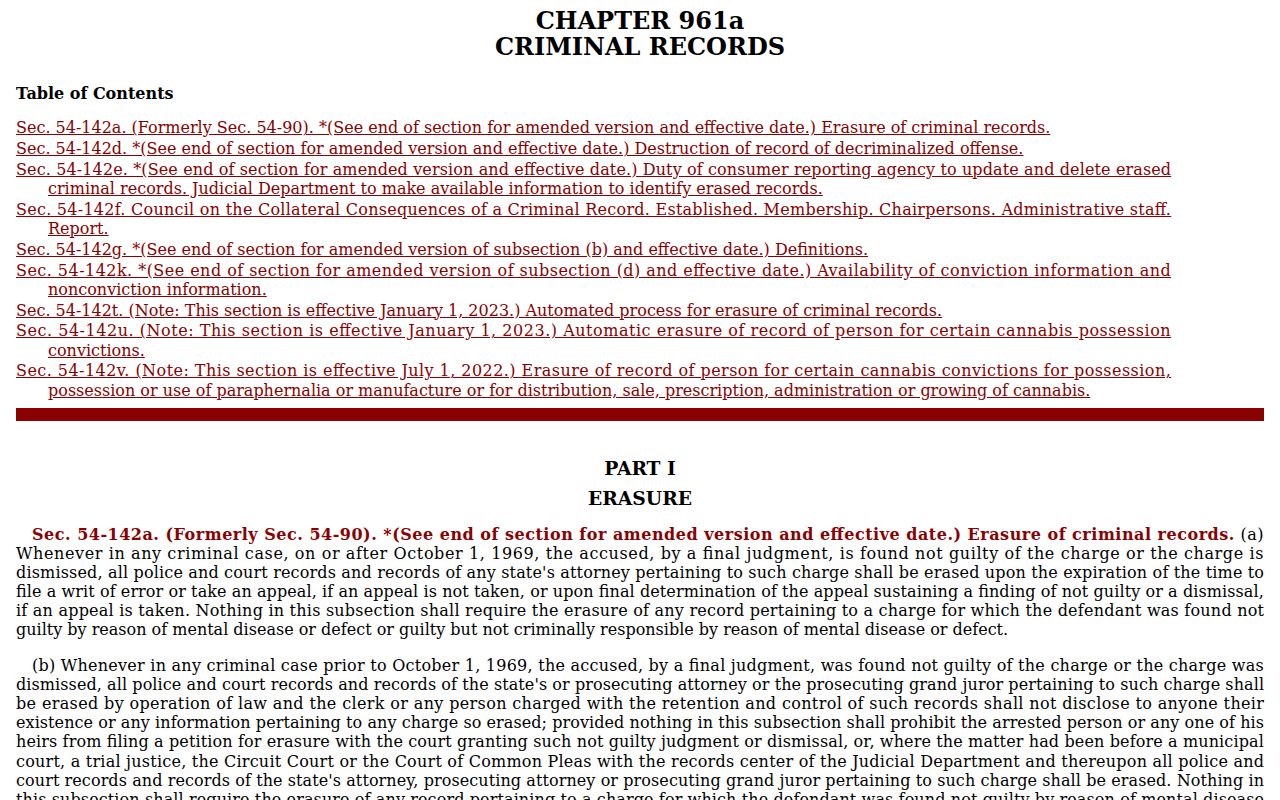
The erasure statute is one reason private background-check results and official criminal court records may not match.
Public Access to Norwalk Criminal Records
Public access to criminal court records is shaped by several Connecticut rules. Conn. Gen. Stat. Sec. 1-210 sets the general public-records baseline for agency records. Conn. Gen. Stat. Sec. 1-215 defines public arrest-record access from the time of arrest and lists protections for witnesses, victims, sealed items, juvenile matters, erased records, and prejudicial pending-prosecution details. Court records also follow Judicial Branch access rules and case-specific orders.
Key Statutes:
Conn. Gen. Stat. Sec. 54-142a controls erasure of qualifying criminal records.
Conn. Gen. Stat. Sec. 46b-124 makes juvenile matter records confidential subject to listed exceptions.
Restricted Norwalk Criminal Court Records
Restricted Norwalk criminal court records include juvenile matters, erased criminal records, sealed warrant materials, sealed reports, protected victim information, witness identities, family violence or sexual assault identifying details, personal identifiers, and material that could prejudice a pending prosecution. Adoption and mental health records are generally not ordinary criminal court records, but they show the same principle: a public docket search does not make every document open.
When a search result is missing or thin, use the official fallback chain. Check the Judicial Branch criminal and motor vehicle tools, verify with the Clerk of the Superior Court or attorney, check Norwalk Police daily logs or FOIA for arrest-side records, and use DOC if the question is current custody. For active warrant concerns, use official court or police contact rather than an unofficial list.